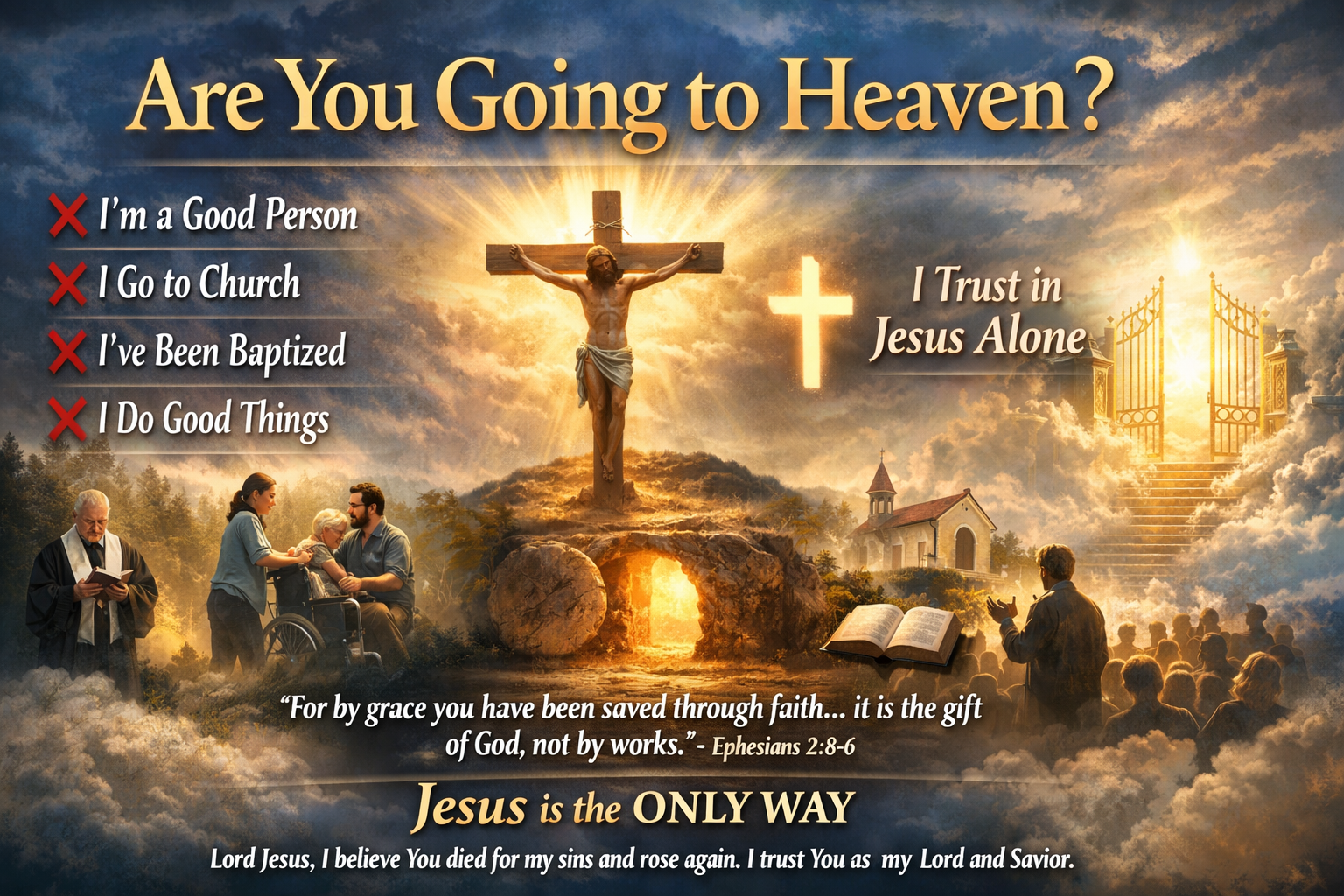
If someone asked you a simple but deeply important question—“Why should God let you into heaven?”—how would you answer?
It’s a question most people don’t think about often, yet it carries eternal weight. When it does come up, the answers tend to sound familiar. Many would say they are a good person, that they try to help others, that they believe in God, or that they attend church. Some might mention baptism or a desire to live a moral life. At first glance, those responses seem reasonable, even admirable. They reflect effort, intention, and a desire to do what is right.
But according to Scripture, none of those things are the reason a person enters heaven.
That truth can feel uncomfortable because it challenges a deeply rooted belief—that goodness can be measured, and that if we do enough right things, we will be accepted. It’s a natural way to think. We compare ourselves to others, weigh our actions, and assume that being “better than most” is enough.
The Bible, however, presents a very different standard.
“For all have sinned and fall short of the glory of God.” — Romans 3:23
This verse removes comparison entirely. It does not say some fall short—it says all. No matter how kind, disciplined, or generous a person may be, everyone falls short of God’s perfect standard. The issue is not effort, but perfection.
That is where the idea of earning salvation begins to break down. Many people believe that good deeds can outweigh mistakes, that kindness can balance wrongdoing. But Scripture teaches that righteousness cannot be achieved through effort alone.
“All our righteous acts are like filthy rags.” — Isaiah 64:6
This does not mean that good works have no value. It means they are insufficient to remove sin. They cannot erase what separates us from God. No amount of effort can produce the perfection that God requires.
Some people recognize this and move closer to the truth. They acknowledge that Jesus died for their sins, but still add something of their own effort—believing that faith plus good behavior is what ultimately secures salvation. While that sounds reasonable, it quietly shifts trust back onto ourselves. It turns salvation into something shared between what Jesus did and what we contribute.
But the Gospel is not about shared credit. It is about complete surrender.
Scripture makes this unmistakably clear:
“For it is by grace you have been saved, through faith… not by works, so that no one can boast.” — Ephesians 2:8–9
Salvation is not something we achieve. It is something we receive. It is a gift, not a reward. That means it cannot be earned, improved, or completed by human effort. It can only be accepted through faith.
This also reshapes how we understand things like church, baptism, and good deeds. These are meaningful and important, but they are not the foundation of salvation. They are responses to it. A person can be involved in all of these things—attend regularly, serve faithfully, give generously—and still miss the core truth if their trust is not placed fully in Christ.
Jesus Himself left no room for confusion on this point:
“I am the way and the truth and the life. No one comes to the Father except through me.” — John 14:6
Not through religion. Not through tradition. Not through effort. Through Him alone.
So what, then, is the right answer to that original question?
It is not based on what we have done, but on what we believe and who we trust. The answer is found in placing full trust in Jesus Christ—believing that He is the Son of God, that He died for our sins, and that He rose again. It is not partial trust or shared reliance. It is complete dependence on Him.
Scripture describes it this way:
“If you declare with your mouth, ‘Jesus is Lord,’ and believe in your heart that God raised him from the dead, you will be saved.” — Romans 10:9
And again:
“Everyone who calls on the name of the Lord will be saved.” — Romans 10:13
This shifts everything. Salvation is no longer about striving—it is about surrender. It is no longer about achieving—it is about receiving.
At the center of this truth is what Jesus accomplished on the cross. He paid the price for sin, took the place that we deserved, and satisfied the justice of God. His resurrection confirmed that sin and death had been defeated. What we could never accomplish on our own was completed fully through Him.
That leads to an important question: if good works do not save us, why do they matter at all?
They matter because real faith produces real change. When someone truly understands what Christ has done, something shifts internally. Gratitude begins to replace pride. Obedience becomes a response rather than an obligation. The desire to live differently grows—not out of pressure, but out of transformation.
Scripture explains this clearly:
“For we are God’s workmanship, created in Christ Jesus to do good works…” — Ephesians 2:10
Good works are not the price of salvation. They are the evidence of it.
In the end, the most important question is not whether we are good enough. The real question is whether we have placed our trust fully in Jesus Christ. Because Scripture makes one promise clear:
“For God so loved the world that he gave his one and only Son, that whoever believes in him shall not perish but have eternal life.” — John 3:16
Heaven is not reserved for those who manage to be good enough. It is for those who recognize that they never could be—and place their full trust in the One who already was.
💭 Reflection
- Am I trusting in my actions, or in what Christ has done?
- Do I see salvation as something to earn, or something to receive?
- What does my faith produce in my life?
🙏 Prayer
Lord, help me to fully trust in what You have done, not in what I can do. Remove any reliance on my own efforts and teach me to rest in Your grace. Strengthen my faith and shape my life so that it reflects Your truth. In Jesus’ name, Amen.
In Christ,
Jeffrey Trester
Please subscribe to my channel.
If this spoke to you, share it with someone who needs it.
Leave a Reply