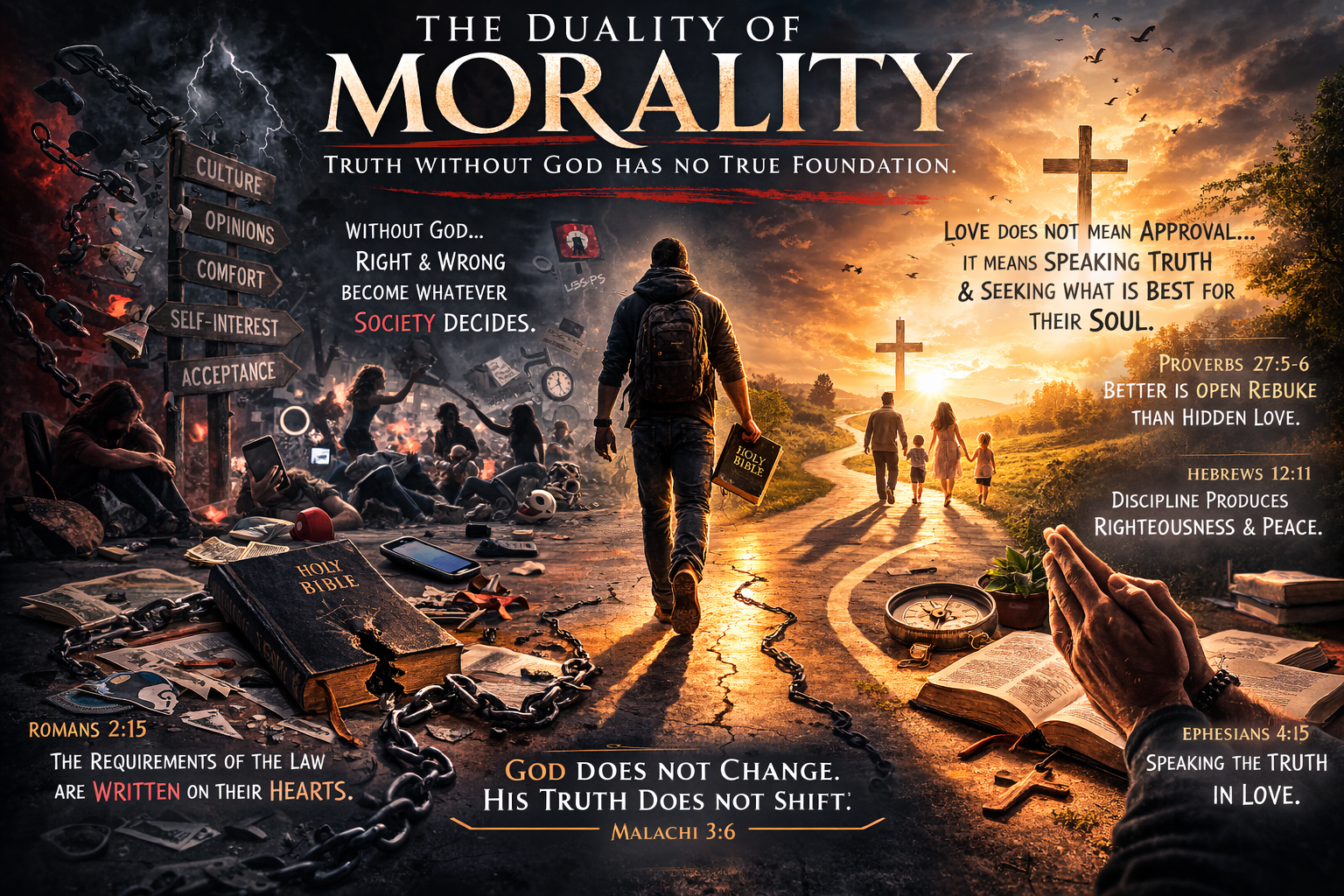
At some point in life, nearly everyone wrestles with the same foundational questions: What is right? What is wrong? And perhaps most importantly, who decides?
At first glance, the moral standards taught in Scripture and those shaped by society can appear similar. Both speak about kindness, justice, and human dignity. But when we look more closely, we begin to see that they often lead in very different directions. Understanding that difference matters, because the foundation we build our lives upon ultimately determines where that life leads.
To understand morality, we have to begin at its source. Where does our sense of right and wrong come from? For those who follow Christ, the answer is not rooted in opinion or cultural consensus. It is grounded in the Word of God and guided by the discernment of the Holy Spirit. Together, they form a moral compass that is not shaped by preference, but anchored in truth.
Scripture teaches that morality flows from God Himself. Humanity was created in His image, and because of that, there is an internal awareness of right and wrong within each of us.
“They show that the requirements of the law are written on their hearts…” — Romans 2:15
This explains why even those who do not actively follow God still experience guilt, conviction, and moral awareness. The imprint of God remains, even when it is not fully understood.
However, when God is removed as the standard, morality begins to shift. It becomes shaped by culture, influenced by politics, and adjusted by circumstance. What is considered right or wrong can change depending on popular opinion, social pressure, or the trends of the moment. History shows that when there is no fixed standard, almost anything can be justified.
This is one reason biblical morality can feel uncomfortable in today’s culture. It does not change. It does not adjust itself to fit the moment or align with shifting expectations. In a world that values personal expression, emotional validation, and individual freedom, an unchanging standard can feel restrictive or even harsh. But discomfort does not necessarily mean something is wrong. Often, it signals that we are being challenged to grow beyond what feels easy or familiar.
One of the most misunderstood ideas today is the belief that love requires full approval. The assumption is that if we truly care about someone, we must affirm every choice they make. But biblical love is not rooted in approval—it is rooted in truth. It is deeper, stronger, and more honest.
Scripture reflects this clearly:
“Better is open rebuke than hidden love. Faithful are the wounds of a friend…” — Proverbs 27:5–6
That is not an easy truth to accept. Real love sometimes requires honesty, correction, and accountability. It means caring enough to speak truth, even when it is uncomfortable.
Jesus modeled this balance perfectly. He showed compassion without compromising truth. When He extended mercy, He did not ignore sin—He addressed it with purpose and direction.
“Neither do I condemn you… go, and sin no more.” — John 8:11
There is a clear order in that moment: grace first, then truth. Not condemnation, and not approval of wrongdoing, but an invitation to transformation.
This leads to another area of confusion—the difference between accountability and judgment. Many people assume that holding someone accountable is the same as condemning them. But these are not the same thing. Condemnation tears down. Accountability, when done correctly, builds up and guides growth.
This principle applies not only spiritually but practically. In leadership, accountability is necessary for development. Without it, mistakes go uncorrected, growth stalls, and individuals and teams both suffer. The same is true in our spiritual lives. God’s correction is not meant to harm us—it is meant to shape us.
“No discipline seems pleasant at the time… but later it produces a harvest of righteousness…” — Hebrews 12:11
Discipline is not punishment. It is training. It is preparation for something greater.
As we begin to align our lives more closely with biblical truth, change becomes inevitable. Our values shift. Our priorities adjust. Even our relationships may evolve. Not everyone will understand those changes, and not everyone will walk that path alongside us.
Jesus spoke about this reality directly, reminding us that standing for truth will not always be met with approval.
“Blessed are you when people hate you… because of the Son of Man.” — Luke 6:22
This can be difficult, but it is part of the journey. Truth does not always align with comfort, and choosing it often comes at a cost.
When people suggest removing God from morality altogether, it creates a deeper issue. Without Him, there is no fixed standard—only shifting perspectives. What is considered right can quickly become wrong, and what was once rejected can become accepted. Culture changes constantly, but God does not.
“For I the Lord do not change.” — Malachi 3:6
This is what makes biblical morality different. It is not based on trends, opinions, or societal shifts. It is based on the unchanging character of God.
At the same time, living out that truth requires balance. It is possible to lean too far in either direction. When truth is presented without love, it can become harsh and damaging. When love is expressed without truth, it can turn into compromise. Scripture calls us to hold both together.
“Speaking the truth in love.” — Ephesians 4:15
That balance is where biblical morality is lived out—not in superiority or judgment, but in humility, honesty, and compassion.
Ultimately, biblical morality is not about being better than others or pointing out their faults. It is about aligning our lives with truth, walking in humility, and loving others enough to be honest. It is about allowing God’s character to shape not only what we believe, but how we live.
💭 Reflection
- Where does my moral compass come from?
- Am I following truth—or cultural influence?
- Do I balance truth and love in how I live and speak?
🙏 Prayer
Lord, help me stand firm in Your truth while walking in love. Give me wisdom to discern right from wrong and humility to apply it correctly. Guard my heart from pride, and teach me to reflect Your character in all that I do. In Jesus’ name, Amen.
In Christ,
Jeffrey Trester
Please subscribe to my channel.
If this spoke to you, share it with someone who needs it.
Leave a Reply