
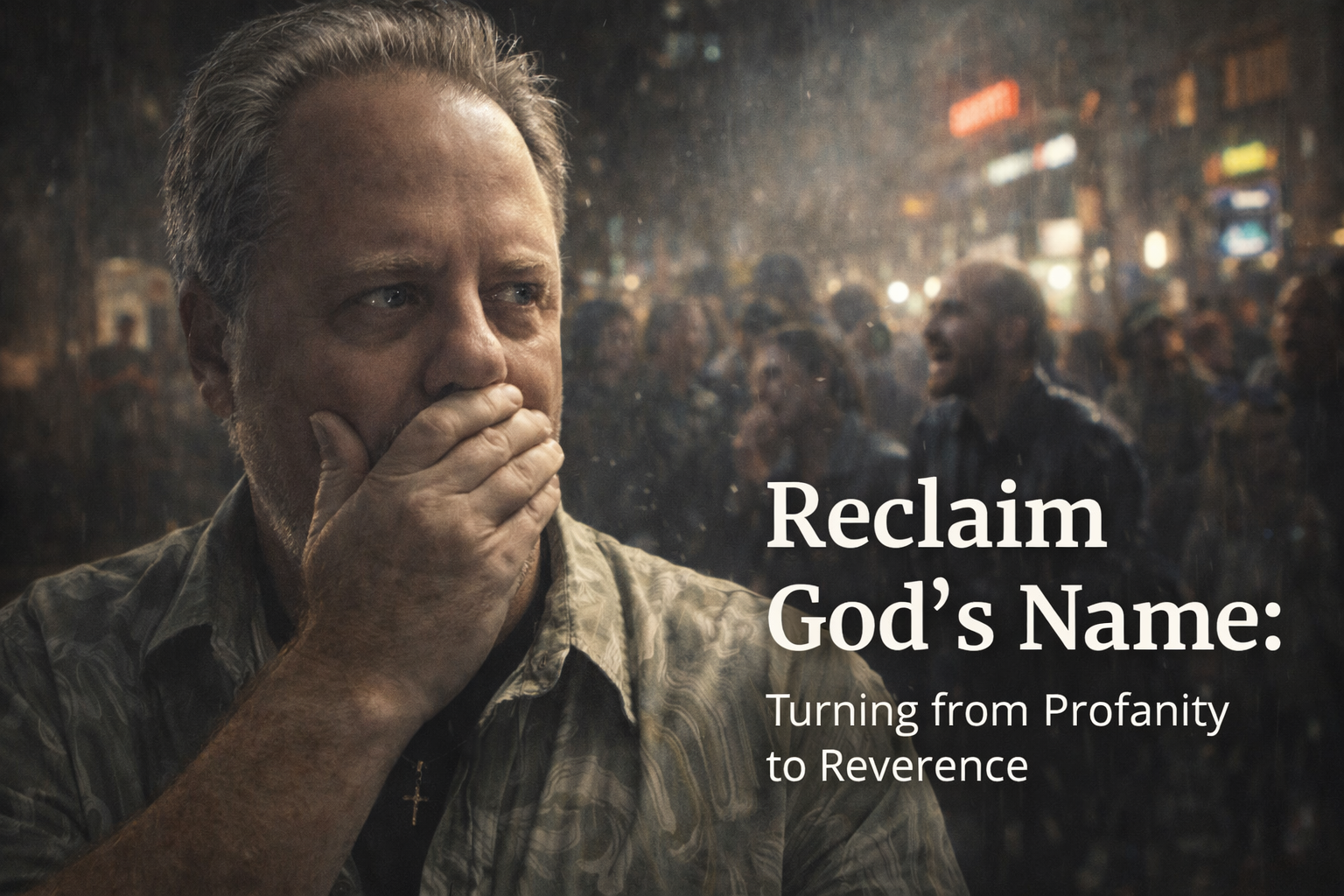
Words carry weight. They are not random, and they are never empty. Every word we speak reveals something deeper—our thoughts, our emotions, and ultimately, the condition of our hearts.
Yet in today’s world, language has become careless.
Everywhere you go, people use the Lord’s name in vain. It has become so common that many hardly notice it anymore. It shows up in everyday conversations, in moments of frustration, in humor, and constantly throughout movies, television, and social media. What was once treated with reverence is now used casually—almost instinctively.
What stands out even more is who often uses it.
Many of the loudest voices using God’s name in vain are the same ones who claim they don’t believe in Him at all. They identify as atheist or agnostic, rejecting the existence of God—yet in moments of anger or stress, His name is the one they call on.
That contradiction reveals something deeper.
How can someone deny God’s existence, yet instinctively use His name when things go wrong?
It exposes a truth that goes beyond logic. Deep down, whether acknowledged or not, there is an awareness of God that surfaces in moments when control is lost.
A Command That Still Stands
God did not leave this issue unclear.
“Thou shalt not take the name of the Lord thy God in vain; for the Lord will not hold him guiltless that taketh his name in vain.” — Exodus 20:7 (KJV)
This is not a minor guideline—it is one of the Ten Commandments.
God’s name is holy. It is set apart. It represents His authority, His presence, and His character. To use His name “in vain” is to treat something sacred as though it were common—to speak it without reverence, without thought, without weight.
And in today’s culture, that is exactly what has happened.
What Our Words Reveal
Jesus made it clear that our words are not random—they are a reflection of what is inside us.
“For out of the abundance of the heart the mouth speaketh.” — Matthew 12:34 (KJV)
If our speech is filled with profanity, anger, or careless use of God’s name, it is not just a surface issue. It is a heart issue.
This is not about perfection—it is about awareness.
When our hearts are filled with frustration, pride, or the influence of the world, those things will eventually come out through our words. But when our hearts are filled with Christ, something begins to shift.
We slow down.
We become intentional.
We begin to notice.
Grace starts replacing harshness.
Reverence replaces carelessness.
Purpose replaces impulse.
The Influence of Culture
There is no denying that culture shapes behavior.
Hollywood, music, and social media have normalized language that once carried weight. God’s name is used casually in entertainment—often in the most trivial or disrespectful ways. Over time, repeated exposure dulls sensitivity.
What once stood out now blends in.
What once felt wrong now feels normal.
But Scripture calls us to something different:
“And be not conformed to this world: but be ye transformed by the renewing of your mind…” — Romans 12:2 (KJV)
We are not called to mirror culture. We are called to be transformed by truth.
And that transformation doesn’t just stay internal—it shows up in how we speak.
The Spiritual Reality Behind It
This is more than habit. It is spiritual.
The enemy rarely starts with something obvious. Instead, he works through normalization. If something sacred can be made to feel common, its meaning begins to erode.
Reverence fades.
Awareness dulls.
Holiness feels ordinary.
Using God’s name in vain may seem small in the moment, but repeated over time, it reshapes how we view Him.
Scripture reminds us to stay alert:
“Be sober, be vigilant; because your adversary the devil, as a roaring lion, walketh about, seeking whom he may devour.” — 1 Peter 5:8 (KJV)
What we allow into our speech will eventually shape what we allow into our hearts.
A Call to Speak with Purpose
Our words should not be accidental. They should be intentional.
“Let no corrupt communication proceed out of your mouth, but that which is good to the use of edifying…” — Ephesians 4:29 (KJV)
This is the standard.
Before we speak, we pause.
Before we react, we think.
Before we echo the world, we choose truth.
Not perfectly—but intentionally.
Transformation Begins Within
Trying to change your language without changing your heart will only lead to frustration.
Real change starts deeper.
“Create in me a clean heart, O God; and renew a right spirit within me.” — Psalm 51:10 (KJV)
When your heart begins to align with God, your words will follow.
You’ll notice more.
You’ll catch yourself quicker.
You’ll choose differently.
Not because you have to—but because something inside you has changed.
💭 Reflection
Take a moment and sit with this honestly:
- What do your everyday words sound like?
- Do you use God’s name casually without thinking?
- Have you become desensitized to how often it’s used around you?
- Do your words reflect reverence—or reaction?
This isn’t about guilt—it’s about awareness.
When you begin to guard your words, you begin to guard your heart. And when your heart aligns with God, your speech will naturally follow.
🙏 Prayer
Heavenly Father,
Thank You for Your truth and for the grace You give, even in the areas where I fall short without realizing it.
Lord, make me more aware of the words I speak. Slow me down in moments of frustration and help me choose words that honor You. Show me where my speech has become careless, and gently guide me back into alignment.
Create in me a clean heart, O God, and renew a right spirit within me.
Fill me with Your presence so that my words reflect Your love, Your patience, and Your holiness. Teach me to treat Your name with reverence—not casually, not carelessly, but with the honor You deserve.
Let my words build others up and point back to You in everything I say.
In Jesus’ name,
Amen.
In Christ,
Jeffrey Trester
If this spoke to you, share it with someone who needs it.
Leave a Reply